Clasp: One Place for the Work I Keep Losing
I built a small tool to gather my scattered tasks, save the good reads, work with Codex, and remember to take cat breaks.
My work did not have a single inbox. It had a small archipelago.
A follow-up lived in Gmail. A promise I made lived in Slack. Planned work lived in Jira. Bugs and ideas waited in GitHub issues. Articles I absolutely intended to read were spread across browser tabs—some of them old enough to have tenure.
Meanwhile, Notion held my meeting notes and personal to-do list. I like Notion as a record of what happened and why. But turning every useful sentence into a task was manual, and manual task creation has a special talent for happening “later.”
Then there was Codex, where much of the actual work got done. It was excellent at helping me investigate, write, and build. For a while, I also tried using Codex to scan all my sources and create the tasks for me. In theory, this sounded ideal: let the agent read everything, surface what mattered, and hand me a tidy list.
In practice, it did not work well for me. I realized that the scan itself was valuable. My email automation rules already filter much of the noise, so quickly reading the remaining emails and messages helps me get grounded in what is actually happening. I absorb the details, tone, and connections better when I see them myself. A generated task list could tell me what to do, but it could not give me quite the same sense of the situation.
I did not need Codex to stand between me and the information. I needed a faster way to capture the follow-ups I noticed while reading it. That became an important principle for Clasp: preserve the intentional scan, then remove the administrative work that comes after it.
So I built Clasp.
The tab tax
None of my tools was the problem. Each one was good at its job. The problem was the space between them.
Every switch carried a tiny tax: open the app, remember what I was looking for, decide whether it was still relevant, copy the context somewhere else, then find my way back. One switch is harmless. Fifty switches turn a thoughtful day into administrative confetti.
I did not want another heavyweight project-management system. I wanted a clasp: one small thing that holds the loose ends together.
What Clasp does for me
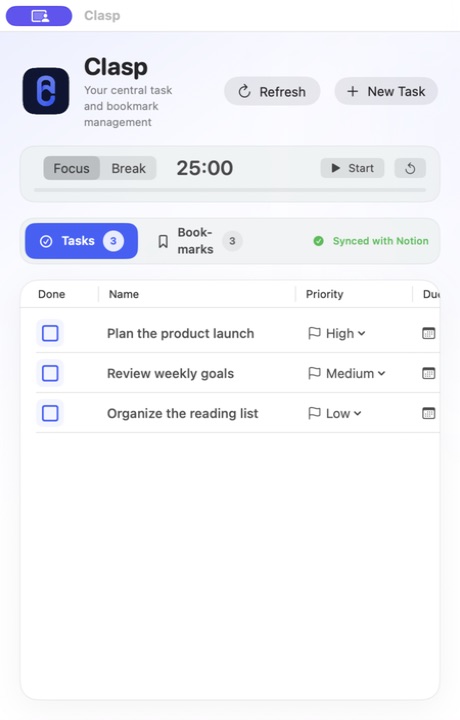
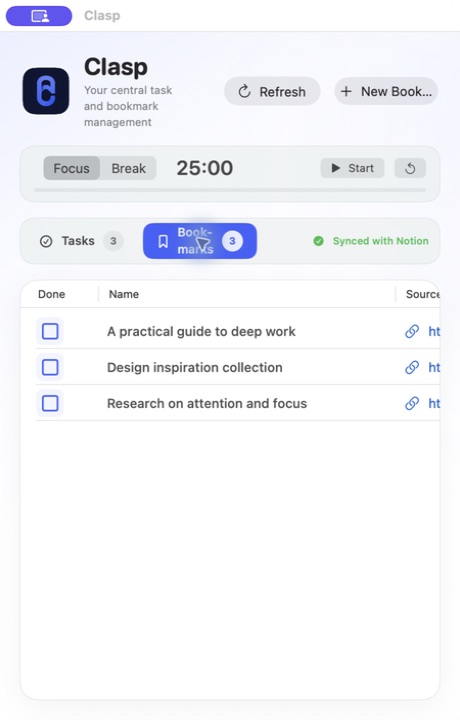
Clasp is a central place for tasks and bookmarks that come from different sources. It gives each item one home without pretending the original source no longer matters.
Pull follow-ups, issues, links, and little “do not forget this” moments into one view.
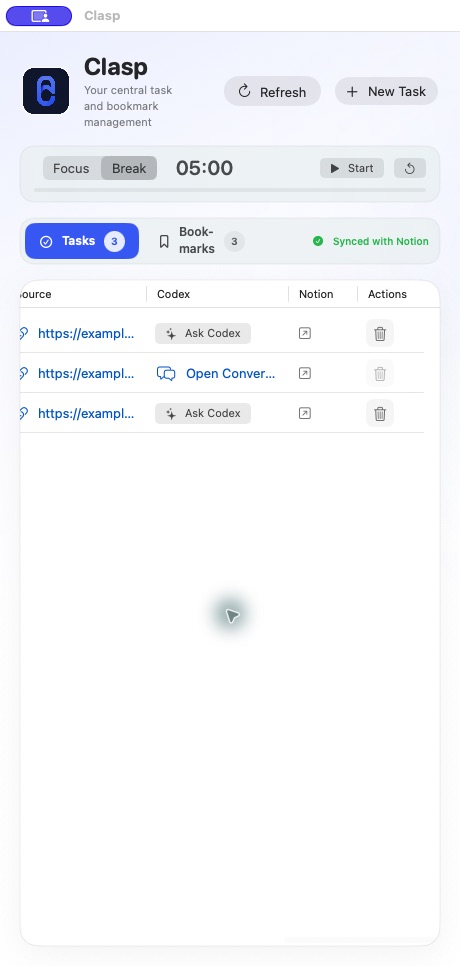
Choose what deserves attention now, start a Pomodoro, and send the work to Codex.
Sync the durable record to Notion and keep task status connected to the work.
The distinction between tasks and bookmarks is important to me. An interesting article is not always an obligation. Sometimes it is simply a thing I want to return to. Giving reading its own lane keeps my task list honest while rescuing good links from tab purgatory.
Notion keeps the memory
I still want Notion in the system. It is where meeting notes become part of a longer story: the decisions, context, and artifacts I may need weeks later. Clasp is not trying to replace that.
Instead, Clasp treats Notion as my record-keeping system. The active work can stay lightweight and close to where I am working; the useful history can sync back to Notion. I get a reliable record without turning “please create the task” into another task.
Codex is the workbench, not the filing cabinet
Codex is where I do the work. Clasp is where I decide what work needs doing and keep track of it.
That separation made the workflow click. I can select a task with its source context, work on it in Codex, and let Clasp track the status. Codex does not need to begin every session with an expedition through five services. I do not need to remember which conversation contains the latest state. The task provides the thread between intention and execution.
This is the part I care about most: Clasp should reduce the amount of task management I ask Codex to do, while making the work I ask Codex to do better informed.
One tomato at a time
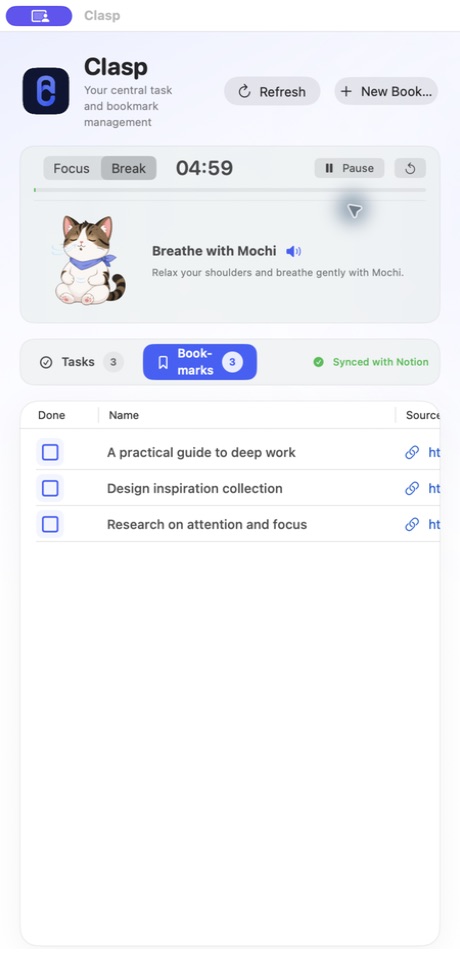
A clean task list does not automatically create concentration. I use the Pomodoro technique because a small, explicit focus window is much friendlier than the instruction “be productive now.” So the timer belongs inside the same loop.
- Pick one thing. Not four “top priorities.” One.
- Start a focus session. Give the task my full attention for one Pomodoro.
- Take a real break. Stand up, look away from the screen, and find Mochi.
- Return or re-plan. Continue with intention instead of drifting into the next notification.
Mochi, my cat, serves as Clasp’s unofficial Head of Break Enforcement. Her performance reviews are frequent, loud, and usually scheduled five minutes before the timer ends.
What I am building toward
Clasp is personal software in the most literal sense: it comes from the shape of my own workday. The goal is not to make every source look the same. It is to give me one trustworthy place to answer a few simple questions:
- What did I promise to follow up on?
- What is worth reading, but not pretending to be urgent?
- What am I working on right now?
- What is Codex doing, and what is already done?
- Did the useful context make it back to Notion?
- Has Mochi received the appropriate number of breaks?
If Clasp works, I should spend less time maintaining the system and more time doing the work—or deliberately not doing the work because I am on a break. Both are wins.
Clasp is open source
If your work also lives in too many places, take a look, try it, or tell me what you would want it to hold together.
Explore Clasp on GitHub